
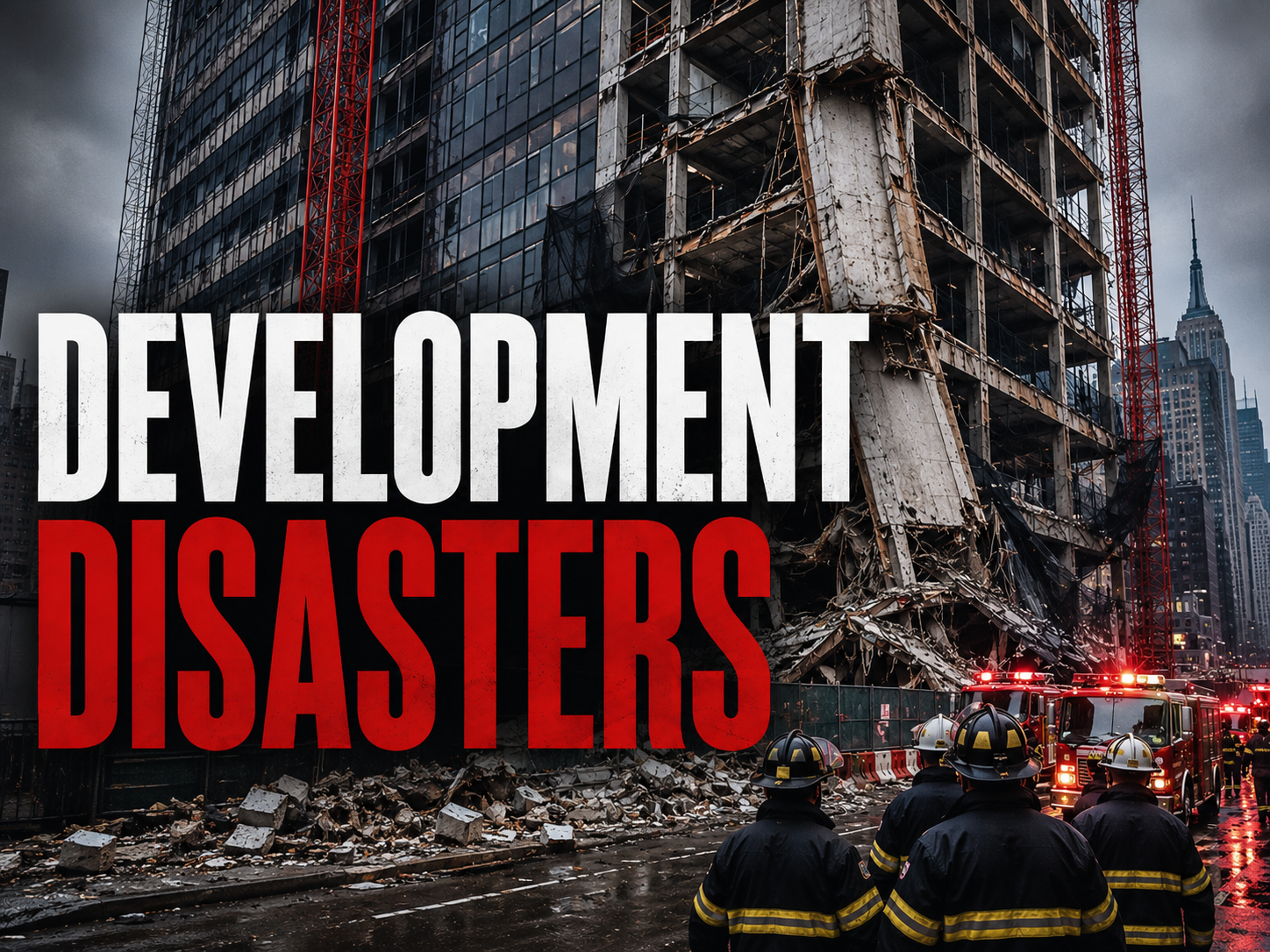
This article is the first in CFDC’s new Development Disasters series, which examines troubled projects to understand what went wrong, what safeguards failed or were missing, and what those cases can teach us about responsible development.
New York City needs more housing, as well as more investment in affordable housing. And it needs to keep building.
But the answer to our housing and development challenges cannot simply be to assume that every rule, review or safeguard standing in the way of a major project is unnecessary “red tape.” Some regulations are cumbersome and should be streamlined. Others exist for a very good reason: to make sure that buildings are safe, that construction is sound, and that the enormous risks associated with complex development are identified before something goes wrong.
Recent events in New York offer some sobering reminders of why that oversight matters.
In July of this year, a 37-story Midtown building undergoing a massive office-to-residential conversion experienced a serious structural emergency when two columns buckled and floors began to sag. Nearby buildings were evacuated and streets were closed while emergency crews worked to stabilize the structure. The building had also accumulated multiple major construction violations in the months before the incident.
Then there is 432 Park Avenue, one of the most recognizable towers on Billionaires’ Row. The 1,396-foot luxury tower has been plagued by problems including leaks, elevator failures, excessive movement and serious façade concerns. A major repair program, reportedly costing approximately $160 million, is now being undertaken to address the building’s defects.
And in Lower Manhattan, One Seaport has become perhaps the city’s most visible example of what can happen when an extraordinarily complex project goes wrong. The 60-story luxury tower at 161 Maiden Lane has remained unfinished amid years of litigation and disputes over its construction and foundation, including concerns about the building being out of plumb.
None of this means that tall buildings are inherently unsafe. New York has built—and continues to build—extraordinary structures safely. Nor does it mean that development should be stopped or that every project should be subjected to endless layers of bureaucracy.
But it does challenge the increasingly common argument that government oversight is simply an obstacle to getting housing built.
The real question is not whether New York should build. It is whether we are doing enough to make sure that what we build is safe, sound, and appropriate for its surroundings before construction begins.
The larger and more complicated the project, the greater the potential consequences when something goes wrong. A structural failure at a small construction site is serious. A failure involving a 60-, 80-, or 100-story building can affect thousands of people, neighboring buildings, streets, businesses, infrastructure, and an entire community.
That is precisely why government has a role.
Developers understandably want projects approved quickly and predictably. And New York should absolutely look for ways to eliminate unnecessary delays, duplication, and bureaucracy. But calling every meaningful review “red tape” risks confusing two very different things: regulation that unnecessarily prevents good development and oversight that prevents bad development from happening in the first place.
The lesson of recent failures should not be that New York should stop building or stop pursuing ambitious development. It should be that ambition has to be matched by accountability.
Before the first shovel goes into the ground, the City should be confident that the plans have been properly reviewed, that structural and construction risks have been fully understood, that neighboring buildings have been adequately protected, and that the developer has demonstrated the capacity to execute the project safely.
That isn’t anti-development. It is what responsible development looks like.
New York does not need less oversight simply because it needs more housing. It needs smarter, more rigorous oversight, particularly when the scale and complexity of a project mean that the consequences of getting it wrong could be enormous.