
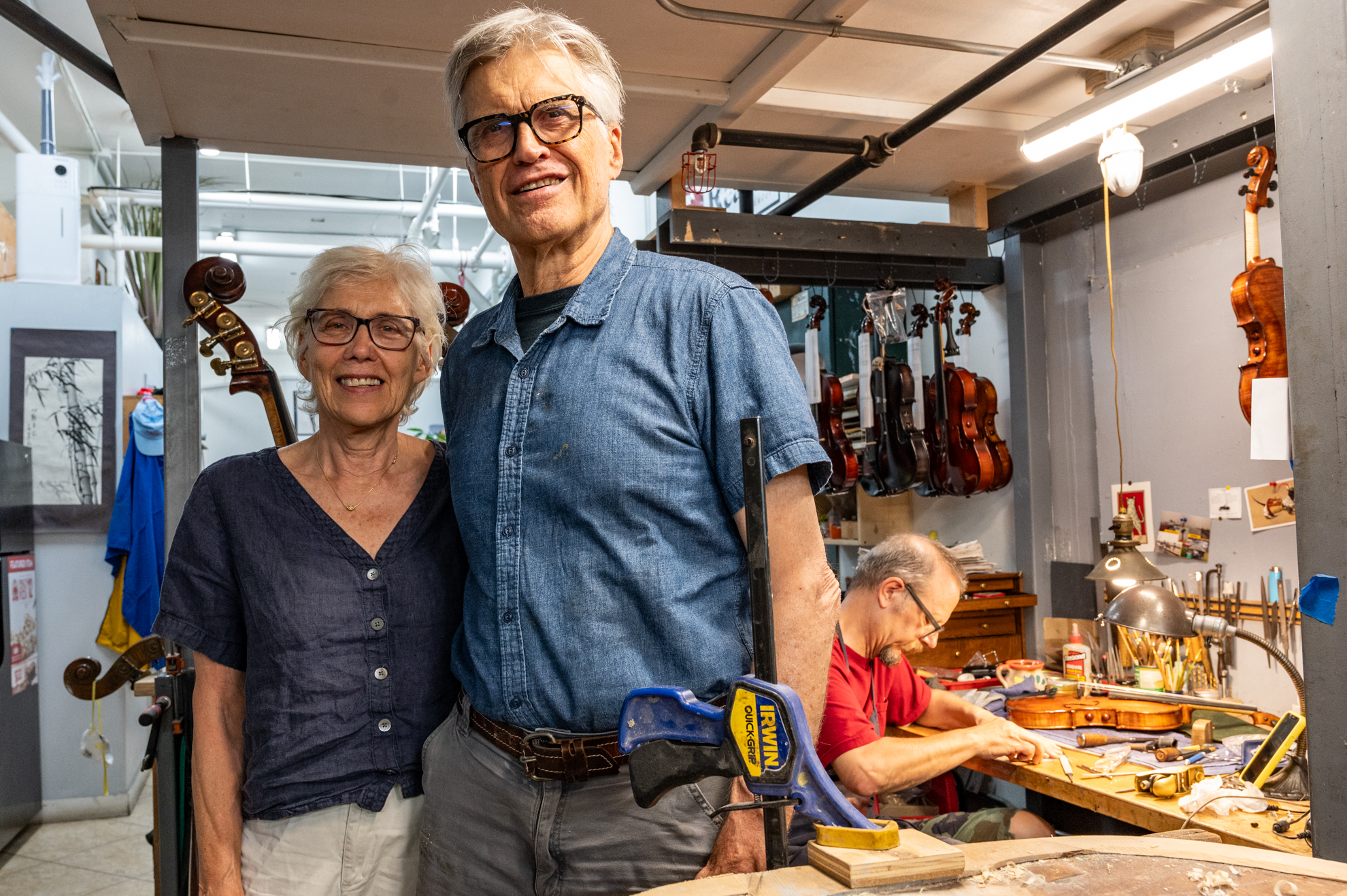
In our fourth installment celebrating Tribeca’s people, places and past, Judy and David Gage reflect on more than 40 years of community- and business-building in Tribeca.
CFDC: When was the business started in Tribeca?
DG: The business started in 1978, and we were incorporated in 1981. We were first at 113 Chambers Street, which Judy saw in an ad in the paper. There was a loft listed, and it was called the City Hall area then. We went down and talked to the landlord. He was asking $395. After that, we had kids and moved right over here to 103 Reade. We didn’t choose Tribeca, really, but the area is great. And Soho was too expensive.
JG: When we first heard the rent, we sat up. We were living in this little hovel on Thompson Street, and we said, “We really can’t afford $395.” And he said, “How much can you afford?” And I wrote it down. We said $325.50.” In the building, there was a guy who sold lingerie. So, it’s a very different area now. There was absolutely nothing here. There was nowhere to eat. There was nothing.
CFDC: What are some early memories of Tribeca that you can share?
DG: Back then, Upper Tribeca was the undeveloped part. My daughter said the other day, “Dad, we used to go and play baseball in an empty lot, and when somebody built a building, we moved to another empty lot.” Tribeca was much more open, and you could park anywhere. We landed in a beautiful area, right by the Hudson River, with the East on the other side. Good transportation, and they built these great schools. Our daughter was in a very first class to go to school at 234. There were empty classrooms there, and there were about 200 kids.
JG: I used to run the Park Place Squash Club. It was open until midnight. People would come down at 11pm and play squash, and my security was a baseball bat. We didn’t have a second home or country house anywhere, so we were very steeped in the city. Our son is a professional musician, so weekends were spent at Third Street Music School Settlement. It’s kind of odd, because without the kids, we don’t have that relationship to the community in the same way.
CFDC: How has Tribeca changed over the years?
DG: It’s totally changed. In fact, we used to stay at the Bond Hotel, because it was $9 a night. If you saw somebody at night, it was a janitor working the night shift, cleaning up the insurance company building. There really were a lot of artists. I would say that the biggest change was the Washington Market Park. It’s a nice, beautiful park that used to be a place where people would dig spots and plant grass. Then Goldman Sachs and everything moved in. The money came in. Tribeca is an entity now unto itself. I don’t know if it can go any larger, that’s for sure.
JG: After the towers came down, David and I looked at each other and thought, “Well, there goes the neighborhood. There goes the real estate.” We were surprised at the way it came back. It’s very family-oriented, and the schools are still good. It’s different coming down here if you’ve been to other parts, like Midtown. You come down here and you feel like, whew, come on. I can breathe. Not everyone is looking for doormen or a club and a gym in the building. They’re looking for just a very chill environment, a home environment for their kids.
CFDC: How would you describe your customer base?
DG: We are more international than local. Back in the good old days, when the world used to be more global, we’d go to Europe three or four times a year. We’d go to China, and we had customers across a lot of Europe. And then a lot of the jazz American orchestras, too.
JG: Because we focus on the bass. The bass is, you know, unique. We’ve always been more specialized. We are boutique. Most people don’t just walk in. Most people who play string instruments like violin, cello, bass, they’re not casual. If a client was committed and needed something, we’d make a travel instrument, a travel bass, because it was so hard to travel with basses. Someone just came in and said to David, “Can’t you just do something to make this smaller?” And he thought, oh, yeah, I can. So, you know, we are always sort of moving with it. The transportation around the city is so perfect. For all of our clients, if they come down from Lincoln Center or from the clubs, there’s a subway right there.
CFDC: What social impact work does the business do?
JG: In the city, we work for the program called UpBeat, which is in the Bronx. They’re teaching orchestral music and arts to underserved kids. It’s a great program, and they started with really nothing. I think they have over 100 students, and they have a wait list. We have interns from their program, usually in the summers. We also work with something called the Horns Project, where we teach and repair instruments in Cuba. We’ve gone down with about 10 artisans, maybe 20 times. There’s actually a great documentary about it, which we are going to show at some point, somewhere in the city. It’s been on the festival circuit.
CFDC: Do you have anything else you’d like to add?
JG: I’ll just tell you David’s famous line whenever I say to him, “You know, if we sold the loft, we wouldn’t have to worry about money.” He says, “You carry me out feet first.”
You can visit David Gage String Instruments online, here.